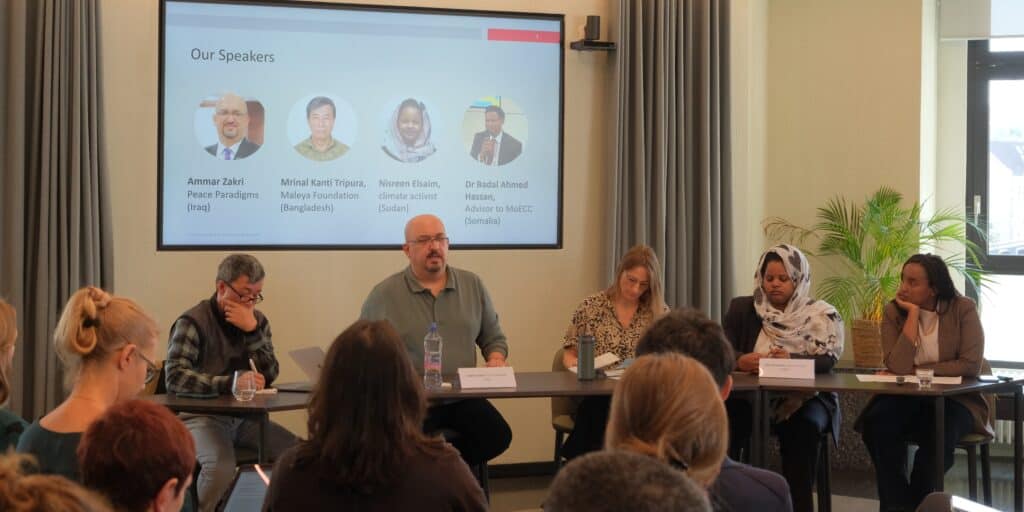
On 7 October, more than 40 guests gathered at the Berghof Foundation in Berlin to discuss climate finance in fragile and conflict-affected contexts with four panellists from Bangladesh, Iraq, Sudan and Somalia. The discussion highlighted common challenges and entry points for climate adaptation and for addressing climate-related loss and damage.
In conflict-affected contexts, political, economic and humanitarian challenges often take centre stage. At the same time, the impacts of climate change shape people’s everyday lives and can exacerbate existing conflicts, particularly where state structures are weak and corruption is widespread. This is evident in all four countries:
- In the mountain regions of Bangladesh, heavy rainfall causes flooding and landslides. Political tensions, armed groups and the lack of recognition of Indigenous rights make climate action more difficult.
- In Sudan, severe sandstorms threaten agricultural fields. Extreme weather and the forecast super El Niño are destroying harvests, and with them the livelihoods of a population already severely affected by the ongoing war.
- In Iraq, extreme heat and water scarcity are compounded by a lack of state structures, with armed groups in some cases taking over state functions. At the same time, civil society actors are helping to establish local water management structures that strengthen community resilience.
- In Somalia, climate-induced water scarcity and food insecurity are exacerbating conflicts. Conversely, violent clashes and a lack of resources mean that measures to adapt to increasingly frequent droughts and water shortages are insufficient, leading to growing loss and damage.
All four examples presented by the panellists show that it’s beneficial to consider the impacts of climate change together with the consequences of war and violence. Local knowledge is crucial to ensure that measures are tailored to local conditions. More funding is needed for adaptation, for dealing with climate-related loss and damage, and for supporting particularly affected population groups.
Funding must fit the context
Funding structures must also reflect the realities of conflict affected regions. Where the political environment is unstable, funding needs to be flexible, long-term and context specific. This includes smaller grant sizes, flexible funding options and greater scope for donors and local organisations to jointly develop and adapt approaches.
Affected communities need direct access to funding. Long-term commitments are more sustainable than short-term emergency aid, which often expires after just one to three years. This requires early information and funding opportunities that allow sufficient time for preparation. Funding levels must be manageable for local organisations and safeguard against corruption.
Strengthening local actors, rights and knowledge
Where funding ends up is just as important. Local organisations often possess in-depth knowledge and close ties to the affected communities. More direct access to resources strengthens their capacities and scope for action. At the same time, the link between the national level and local communities needs to improve.
This includes recognizing the rights of Indigenous peoples and local communities and ensuring they are protected in a binding way within climate projects. Indigenous knowledge is central to climate mitigation, adaptation and the management of loss and damage. Dedicated policies for conflict-affected regions can help support this. Climate funds and other financing instruments should earmark a mandatory share of their resources for projects in conflict-affected regions. In this spirit, the event also recommended an Indigenous Peoples Policy for the Fund for Responding to Loss and Damage (FRLD) that specifically takes account of projects in Indigenous territories.
Connecting and strengthening existing structures
New structures are not needed everywhere. Collaboration between local organisations can link existing knowledge and capacities, create synergies and help avoid duplication and gaps.
The discussion in Berlin made one thing clear: as climate and security issues become increasingly intertwined, local perspectives, human security and existing capacities must be given greater weight. They form the basis for conflict-sensitive and peace-positive climate action, as well as for financing that can make a real difference on the ground.
More information
- About our work at the intersection of peace and climate
- Learn more about the German chapter of the ECCP
- Learn more about our member organisation, the Berghof Foundation
