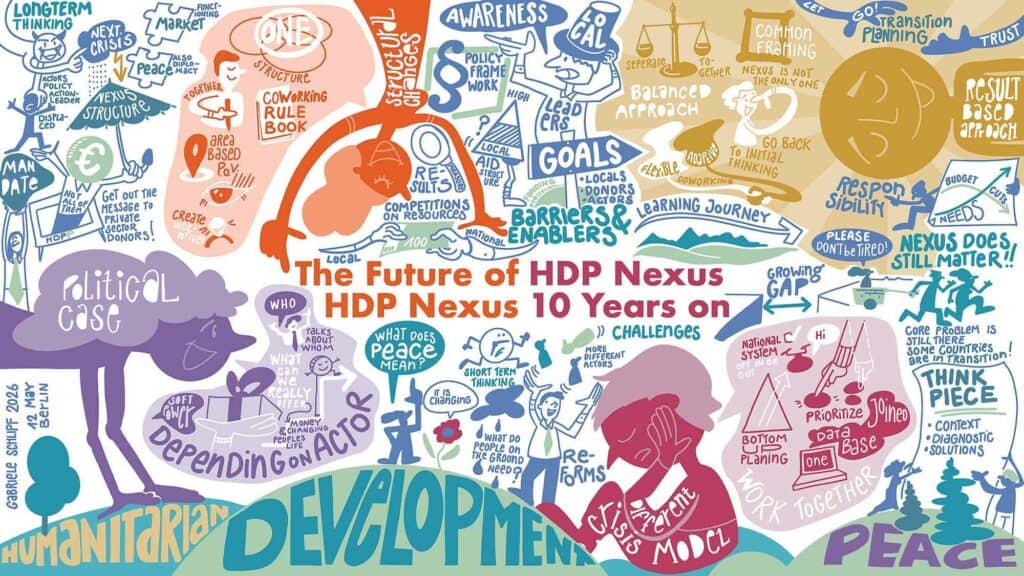
Ten years after the World Humanitarian Summit, the Humanitarian-Development-Peace (HDP) nexus faces its greatest test yet: as global crises intensify and worldwide humanitarian needs reach record highs, the conditions necessary for its effective implementation are coming under increasing pressure. The New Way of Working, agreed upon at the 2016 World Humanitarian Summit, provided political momentum for more closely integrating humanitarian aid, development cooperation, and peacebuilding. Today, however, it is clear that geopolitical fragmentation, protracted conflicts, the consequences of the climate crisis, and increasing fragility pose enormous challenges to the multilateral system. Development gains are being lost, while humanitarian actors are increasingly forced to prioritise their aid in the face of dwindling resources. The crucial question, therefore, is no longer whether the nexus is relevant, but how it can be successfully implemented under these conditions.
That question is at the centre of an international reflection launched in early 2026 by the German Federal Ministry for Economic Cooperation and Development (BMZ), together with the DAC-UN Dialogue – a formal dialogue and coordination framework between the OECD’s Development Assistance Committee (DAC) and the United Nations (UN). The sector project ‘Fragility and the HDP Nexus’ run by the Deutsche Gesellschaft für Internationale Zusammenarbeit (GIZ) is providing technical support for this process.
Implementation, not reinvention
At the heart of the process is the think piece ‘Ten Years On: Time to Double Down on the HDP Nexus’, which Rachel Scott and Damian Lilly produced on behalf of the BMZ. Its central message is clear: the nexus does not need a new concept, but rather better political, institutional and financial framework conditions. It should evolve from a coordination-based approach into a strategic framework that actively shapes political priorities, funding decisions and joint action.
To this end, the think piece proposes a crisis model that integrates humanitarian aid, development cooperation and peacebuilding from the outset, and is more closely aligned with local priorities than previous approaches. The focus is on national and local ownership, long-term funding and measurable improvements for people affected by crises. Success, the authors argue, should be measured not so much by the number of joint strategies or coordination mechanisms, but rather by whether joint action reduces vulnerability, safeguards development progress and reduces recurring humanitarian needs in the long term.
Input from Addis Ababa and Berlin
These recommendations were discussed in spring 2026 during regional consultations in Addis Ababa, as well as at the DAC-UN Dialogue and a public high-level panel discussion in Berlin. In Addis, representatives from partner governments, donors, United Nations agencies, international organisations and civil society from Ethiopia, Somalia, Chad and Mozambique shared their experiences of implementing the Nexus in fragile contexts. The Berlin consultations further discussed the policy and institutional implications of these experiences for the future of the nexus.
Participants in the panel discussion ‘10 Years after the World Humanitarian Summit – Discussing the Future of the HDP Nexus’ included Dr Henning Plate (BMZ), Ralf Südhoff (Centre for Humanitarian Action), Verena Knaus (UNICEF Germany), Dr Chris Coulter (Berghof Foundation) and Habib Ur Rehman Mayar (g7+ Secretariat).
Despite differing perspectives, a broad consensus emerged from the discussions. Firstly, it is not the fundamental concept of the HDP nexus that is up to debate, but rather its implementation. Secondly, funding mechanisms, institutional incentives and mandate-related responsibilities must be geared more strongly towards joint outcomes. Thirdly, there needs to be more consistent involvement of national and local actors, as well as a stronger focus on prevention, resilience and peacebuilding – without compromising humanitarian principles. At the same time, it was emphasised that international financial institutions should be more closely involved and that needs-based action should be maintained even under growing geopolitical pressure.
Outlook
These findings will now be incorporated into a joint position statement by like-minded partners within the OECD International Network on Conflict and Fragility (INCAF) and are intended to shape the debates leading up to the 2026 UN General Assembly and beyond. For the BMZ, GIZ and their partners, the process provides concrete guidance on how to align programmes, financing instruments and partnerships more closely with joint outcomes – thereby providing important impetus for the implementation of the BMZ’s reform plan ‘Zukunft zusammen global gestalten’. Ten years after the World Humanitarian Summit, it is clear that the real test for the nexus lies in translating the aspiration for joint impact into concrete political and operational practice amidst increasingly challenging global conditions.
More information: