
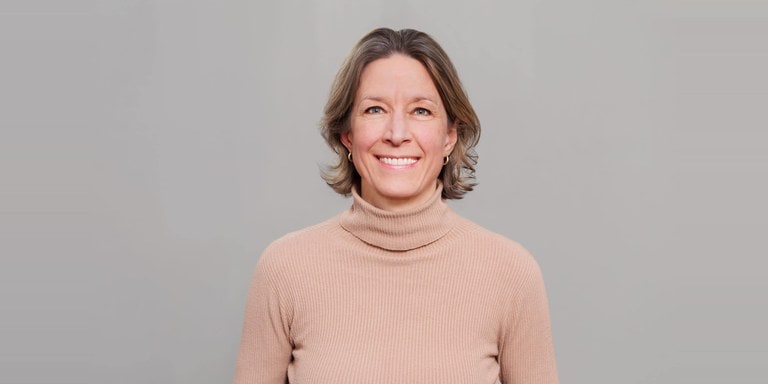
FriEnt: In your opinion, which debates on peace and security policy had the greatest impact on the Catholic Day?
Dorothee Klüppel: What I observed in Würzburg was a shared understanding that peace can no longer be viewed as the antithesis of security, but that the two must be considered together – though not solely in military terms. The Katholikentag brought together questions of internal and external security, Europe, global justice, sustainability and responsibility for creation. Security was not reduced to deterrence and rearmament, but discussed in the context of democracy, social cohesion and international responsibility.
At the same time, it was clear that the Church cannot – and does not wish to – limit itself to internal debates on this topic. The President of the Central Committee of German Catholics (ZdK), Irme Stetter-Karp, emphasised in Würzburg that a Church which is committed to human dignity, solidarity and concrete action in times of need is, by its very nature, a political Church. This was precisely what was evident at the Catholic Day: a public struggle for democracy, social cohesion and international responsibility.
What insights did you take away on how peace, security and development connect – and what does the Catholic Church contribute to this?
The most important insight for me was this: without development, there can be no sustainable security, and without justice, no resilient peace. This perspective was inherent in the Katholikentag itself, as socio-political and global issues were deliberately considered in tandem.
“This is precisely where I see the Church’s most important contribution: thinking about security in a people-centred rather than power-centred way.“
The Catholic Church does not adopt a naively pacifist stance, but is guided by the principle of just peace. This means that it does not ask how violence can be legitimised, but rather how violence can be prevented, conflicts resolved and the conditions for peace strengthened.
Pope Francis has repeatedly reaffirmed this perspective and called for a concept of security that places people at the centre.
Applied to present day, this means that peacebuilding policy requires a holistic concept of security. Hunger, displacement, destroyed livelihoods, the impacts of climate change, debt crises and institutional weakness are not peripheral issues, but drivers of conflict. That is why development cooperation is not a kind gesture, but part of a forward-looking security policy. This is precisely where I see the Church’s most important contribution: thinking about security in a people-centred rather than power-centred way.
At the press conference with Carlo Masala, you said that churches have greater staying power in peace processes. What makes church actors particularly strong in this regard?
Churches often have greater staying power because they don’t just work on a project-to-project basis, they work through long-term relationships with people. Whilst state and international actors often operate in cycles of mandates and funding periods, church networks are present in many places for decades – through parishes, dioceses, religious orders, schools, health centres and youth work. This continuity builds trust, particularly where state institutions are weak or perceived as biased.
At the same time, I would not romanticise this role. Churches can only be credible peace actors if they themselves remain open to learning – that is, if they address abuses of power, take women seriously, act in a synodal manner and are aware of the ambivalence of religious language. This is precisely why it was important that synodality, power and renewal were also discussed openly in Würzburg. The capacity to promote peace externally and the capacity for internal reform are closely linked.
Which church actors do you see in Misereor’s partner countries as particularly important agents for peace?
In crisis-affected regions, grassroots church structures such as religious orders, church commissions for justice and peace, or Catholic educational and healthcare institutions are often the first point of contact for people. Particularly in fragile contexts, they are often perceived as more credible than state actors because they remain by the population’s side even in times of crisis. The most effective church-based peace actors are often not the big names, but the reliable local mediators – women’s organisations, trauma counsellors, youth leaders, parish representatives, human rights groups, church radio stations and interfaith platforms. Peace work succeeds where churches maintain social spaces in which trust can grow despite violence. This is often unspectacular work, but of enormous strategic significance.
What are the consequences of the shift to the right, rearmament and cuts to international cooperation for crisis prevention and peacebuilding?
Above all, they create a dangerous imbalance. If Europe responds to threats primarily through rearmament, whilst at the same time cutting development cooperation, civilian conflict management and peacebuilding, it is investing more in reacting to crises rather than in preventing them.
“Cutting back on development and peace policies may save money in the short term, but it comes at a cost in the long term – in form of greater instability, displacement and violence.”
The shift to the right further exacerbates this problem, as it is often accompanied by nationalism, isolationism, mistrust of multilateral cooperation and a devaluation of human rights.
Cutting back on development and peace policies may save money in the short term, but it comes at a cost in the long term – in form of greater instability, displacement and violence.
A strong development policy that bolsters civil society structures is a key building block for democracy, peace and stability. International cooperation must therefore not be narrowed down to security policy, nor undermined by budget cuts.
What is needed today to ensure that peace policy remains effective amid new geopolitical tensions?
Firstly, it requires perseverance and a willingness to invest in prevention, even though its successes are never as spectacularly visible as military responses. Peace policy often fails not because of a lack of analysis, but because of the short-term nature of political attention. This is precisely why civil society and church actors are so important: they keep relationships and spaces for dialogue open long after public attention has moved on.
“Peace policy often fails not because of a lack of analysis,
but because of the short-term nature of political attention.”
Secondly, it needs an integrated approach that brings together diplomacy, humanitarian aid, development cooperation, climate justice, debt relief, the protection of human rights and local peace-building. Pope Francis has repeatedly emphasised that peace is based on justice and the restoration of just relationships.
Pope Leo XIV further stresses that even when a war has ended, societies remain scarred by the past – by armed gangs, weakened institutions and manipulative external influences that undermine political and social life.
Thirdly, it needs moral clarity without moral simplification; in other words, a clear stance in support of the victims and the defence of human dignity and international law, without reducing complex conflicts to simplistic ‘friend or foe’ narratives. The Church can play an important role here by persistently advocating for human dignity, the capacity for dialogue and the capacity for reconciliation.
Dorothee Klüppel is Head of the Africa and Middle East Department at Misereor, a member organisation of FriEnt, and also represents Misereor on FriEnt’s Steering Committee.
