What are you looking for?

PUBLICATION

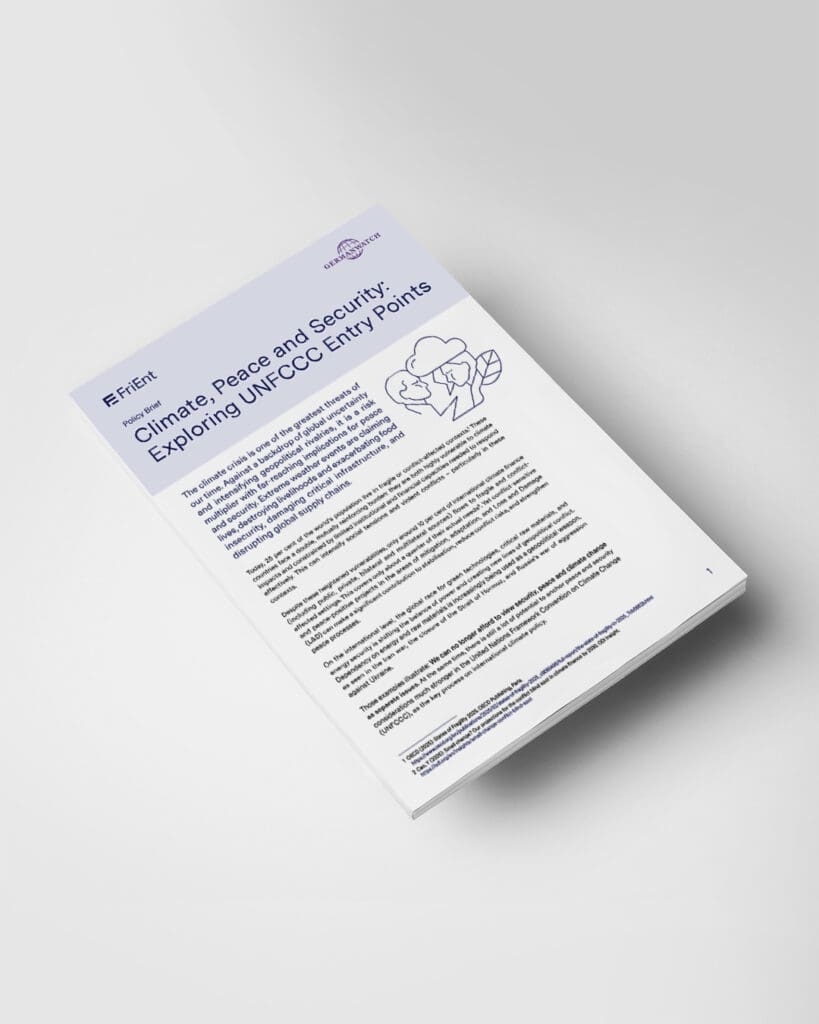
Climate, Peace and Security: Exploring UNFCCC Entry Points

This policy brief explores how the climate-peace-security nexus can be better integrated into the United Nations Framework Convention on Climate Change (UNFCCC) processes. It identifies concrete entry points within negotiations on adaptation, mitigation, and loss and damage, and sets out recommendations for COP31 and beyond.

The authors build on two expert roundtables convened by the Working Group on Peace and Development (FriEnt) and Germanwatch, with participants from civil society, academia and the German government. They show that while recent initiatives such as the COP28 Declaration on Climate, Relief, Recovery and Peace have laid important groundwork, peace and security still play too small a role in formal UNFCCC negotiations. The brief offers concrete recommendations on how to better connect climate, peace and security, and calls for COP31 to move from recognising the nexus to embedding it across negotiations and implementation.

No authors assigned to this post.

Share
Download
File type: PDF
Get in touch
Do you have questions about this article, or would you like to contact the FriEnt team?

Related articles

[tag_names_card]

New to the FriEnt team: Peer Krumrey

Since September 2026, Peer Krumrey has been part of the FriEnt team. He joins FriEnt on secondment from the Friedrich-Ebert-Stiftung (FES), where he works as a programme officer for peace and security in the Division for International Cooperation, Global and European Policy. At FriEnt, he focuses in particular on peace and security as well as peace and development.
[tag_names_card]

“A conflict is not forgotten, because the headlines move on”

At FriEnt’s latest Forgotten Conflicts series discussion, held on 26 August in Berlin, experts and practitioners from Nigeria and Germany explored the drivers and consequences of violence in the country’s Northwest and Middle Belt. The discussion challenged narratives that portray the violence primarily as a religious conflict and highlighted the need to address climate stress, land scarcity, governance gaps and the erosion of livelihoods, while strengthening locally rooted approaches to peacebuilding.
[tag_names_card]

“Security is more than just military strength”: Catholic Responses to Armament and Crisis

The Katholikentag in Würzburg has shown that peace, security and development go hand in hand. In this interview, Dorothee Klüppel, a member of FriEnt’s Steering Committee and Head of the Africa/Middle East Department at Misereor, explains why security is more than just military strength, why justice, democracy and international cooperation are key prerequisites for sustainable peace and what special role church actors play in this – particularly in times of rearmament and geopolitical tensions.
[tag_names_card]

The Humanitarian-Development-Peace Nexus at a Turning Point

How can the Humanitarian-Development-Peace (HDP) nexus effectively deliver on its promises amid mounting crises, shrinking resources and rising political tension? Lena Pönisch, Deutsche Gesellschaft für Internationale Zusammenarbeit (GIZ), shares the key findings of an international reflection process and explains why, today more than ever, better political, institutional and financial frameworks are needed to achieve joint impact in crisis contexts.

Related articles