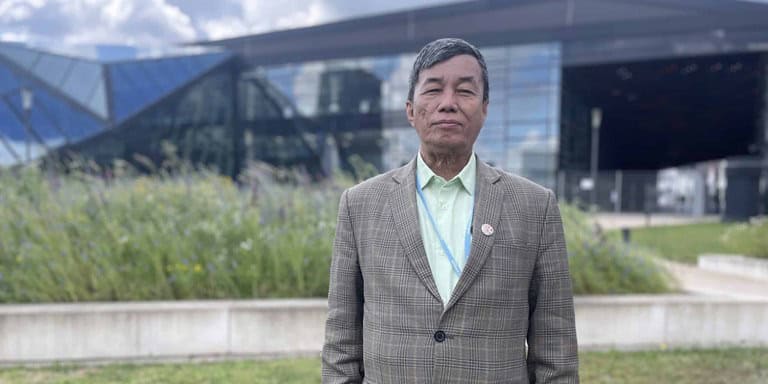
FriEnt: You are a member of the Bangladesh Indigenous Peoples Network on Climate Change and Biodiversity (BIPNet) and the steering committee of the Eastern Himalayan Network on Climate Change (EHNCC). How are the daily lives of Indigenous communities impacted by climate pressures?
Mrinal Kanti Tripura: The Chittagong Hill Tracts, where I come from, are the only hilly region of Bangladesh and part of the Eastern Himalayan region. It is an area of mountains, forests and rivers with very rich biodiversity. The Eastern Himalayas are still one of the world’s biodiversity hotspots. But climate change is having a serious impact on the daily lives of Indigenous Peoples because we live in a very fragile ecosystem. Our livelihood depends on nature, on forests, rivers and the land. We are already experiencing erratic rainfall, prolonged droughts and glaciers melting across the region. These changes affect our lives in many ways. They threaten our food security, our livelihoods, our culture and our traditional knowledge systems. Climate change is putting all of this at risk.
Climate stress and conflict often go hand in hand. Have you seen climate pressures only increase tensions, or can they also create opportunities for peacebuilding?
Many Indigenous territories are already conflict-prone for different reasons. There are conflicts within communities and also conflicts between Indigenous Peoples and the state. Climate change adds another layer of pressure to communities that are already vulnerable. But every conflict also creates an opportunity. When climate change has severe impacts on communities, people have to come together to survive. Even if they are in conflict, they have to work together to respond to the climate crisis. That is where opportunities for peacebuilding can emerge.
What are the three most urgent needs of Indigenous communities right now to adapt to these challenges?
First, Indigenous Peoples need to be recognized as Indigenous Peoples by their own states. Our customary landownership systems also need to be recognized, as well as our right to self-determination.
Second, our culture, livelihoods and knowledge systems need to be respected, recognized and integrated into national policies. Indigenous knowledge has an important role to play in responding to climate change. Finally, Indigenous communities need access to climate finance. We need financial support that is accessible and reaches communities directly so they can respond to the challenges they face, whether the support comes from governments or from international partners.
You are here at SB64 in Bonn, where decisions are made that affect millions of people around the world. What is the one thing you wish decision-makers in the negotiating rooms truly understood?
As an Indigenous person, I want negotiators to understand that Indigenous peoples live with nature. We know how to live in harmony with nature because our lives depend on it. I also want them to understand the rights of nature. Without nature, Indigenous Peoples cannot live. And without Indigenous Peoples, nature cannot stay as it is. Our future is connected. Most importantly, negotiators need to understand the reality on the ground – the reality Indigenous communities are facing every day because of climate change. Those realities should guide the decisions that are made here.
Thank you very much.
More information:
